
Playful facilitation: what actually makes it work
You walk into a room of adults with job titles and ask them to notice what the universe is throwing into their hands. Half of them look like they are in the wrong meeting. Whether the next 20 minutes work has almost nothing to do with the exercise, and almost everything to do with two things that happened before it.
These notes come from a conversation with Stefano on the Facilitabile podcast. The full transcript is linked at the end.
Where playful facilitation actually comes from
I graduated in psychology and started out as a trainer. At some point I found applied improvisation, and when I started using it I noticed I was no longer doing classical training: I was not teaching content, I was giving people experiences, and the learning in the debrief came from the participants, not from me.
That is when I understood that what I was doing had a different name, and I found the field of facilitation. Applied improvisation is an approach, not an answer to every problem a team or an organization has, so I kept learning other things. But it stayed my main approach, which is why I call myself a playful facilitator.
The two things that make a strange request work
1. You have to have been the participant first
Before you do this with others, you should have done it yourself, as a participant. If you are not comfortable making fun of yourself and having people laugh at that, it shows immediately, and you are not credible. And if you are not credible, people will not come with you into the process, no matter how well designed it is.
2. Slowly out of the comfort zone, and say it out loud
The second is how you create psychological safety while still moving people. I name it explicitly: I am going to take you slowly out of your comfort zone, and hopefully we will not get into your panic zone. People laugh, and the sentence does two jobs at once. It sets expectations, and it tells them that someone is watching the boundary.
When I ask clients why they chose a facilitator instead of a more charismatic performer who could run similar activities, the answer is usually the same: they wanted to take a risk with someone who can hold the space and make sense of what happens, not only someone who challenges them.
People do not need to be challenged. They need someone who can hold what happens after the challenge.
The messages you send before anyone speaks
A session starts long before the first exercise. What message does the invitation email send? What message does the manager of that group send when announcing it? What message does the room itself send, and the way the furniture is arranged?
All of these prepare people for what is about to happen, more unconsciously than consciously. If the email is formal and the room is set up in rows, no opening exercise will undo that in ten minutes. So the design starts with those messages, not with the agenda.
Calibrating during the session, in public
Even with a design in hand, I look at the reactions after each activity and recalibrate: that was maybe too much, or they can handle more, so I can go deeper or choose something different.
What some facilitators would not do, and I do, is say it out loud. At a conference I announced that I was going to run a different activity than the one I had planned. Participants do not read that as weakness. They read it as: he adapts to us. Announcing the change is part of the process, not an admission that the process failed.
An exercise that scales to a large room
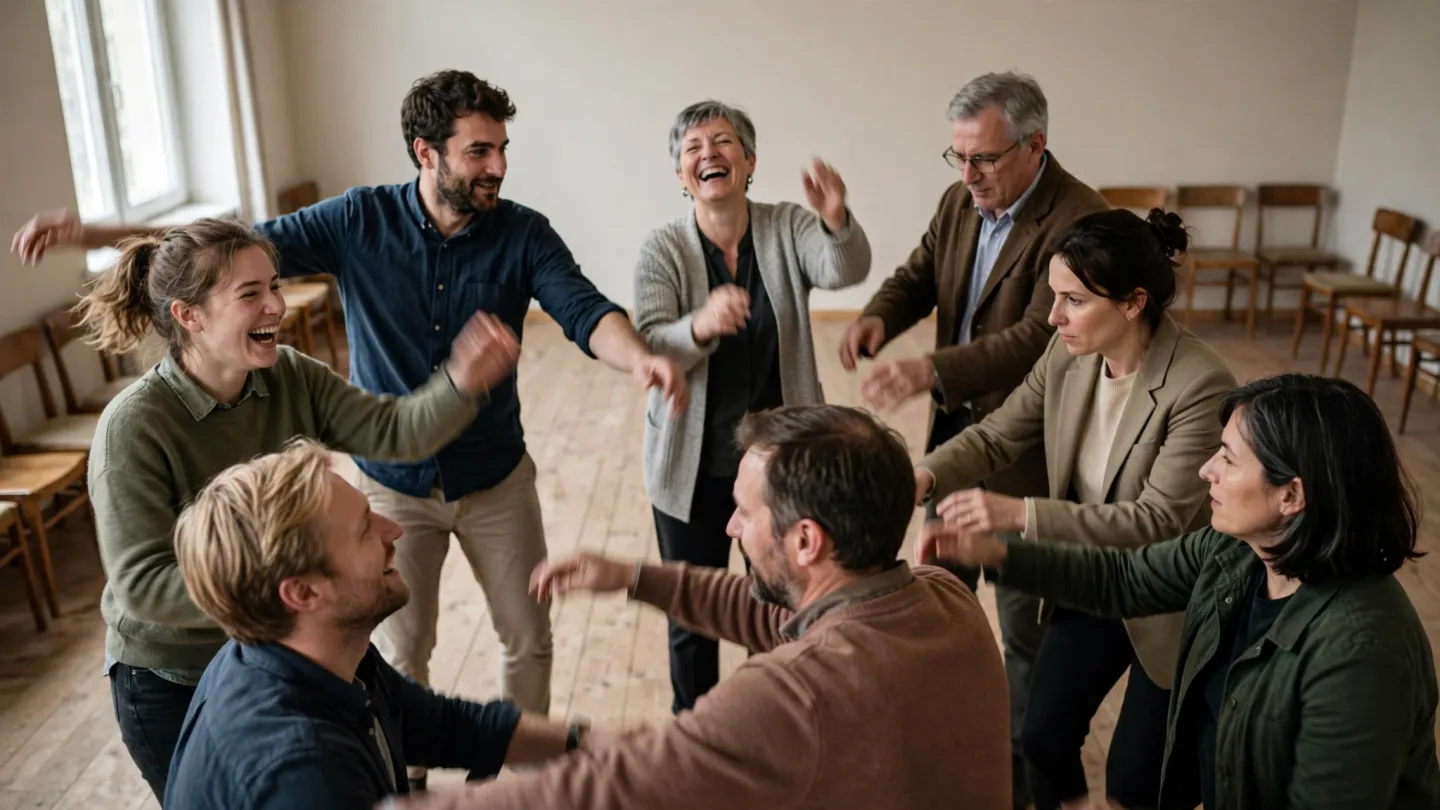
The worst yoga teacher in the world. It is a mirroring activity, and its trick is that the challenges come from participants, not from me, which makes them much easier to accept.
- I give the first example. Hands over my eyes: this is the pose of people who are in the room but would rather be somewhere else. Everyone copies it, and by copying it they get a sense of it.
- Then I ask who wants to propose the next pose, connected to our topic.
- It runs as long as the energy lasts. In a smaller workshop, everyone gets to propose one.
In a conference room with 150 people or more, not everyone can have a voice in every activity, so you need activities that involve everybody physically, and separate ones where individual voices are heard. The reason this one earns its place early is that once a room has followed each other's proposals once, following the rest of the process becomes much easier.
Why the playful part works at all
The mechanism is the same one that projective methods use in coaching and psychotherapy. When you play a pirate or a zoo manager, you allow yourself behaviours you would not allow yourself in your normal role, in front of colleagues and managers. The distance from yourself is what makes the behaviour possible.
It is also why a game like the pirate ship works before a serious conversation: the activity lowers defences, and then you transfer what happened into professional life. The transfer is the work. Without it, you ran a nice game.
Emotional culture, the part organizations skip
When we talk about culture, we usually mean mission, vision, values, competencies, strategic plans. That is the rational part. There is also an emotional part: the sum of how people feel in the organization.
There is substantial research showing that how people feel in their teams correlates directly with results, with satisfaction, motivation, engagement, loyalty, burnout, and with the experience they give clients. These are business metrics, and they are usually approached very superficially.
What I like about working on it in a facilitated way is that it is not an emotional intelligence course about what emotions are and how to control them. It is a team naming what it needs to feel in order to do good work, for example creative, free and appreciated, and also what it does not want to feel, because frustration, stress and overwhelm do show up.
The important shift happens at the end. Usually the emotional side of work is assigned to someone else: HR should do something, the manager should do something, the CEO should do something. After a session like this, people realize that what happens in their team is largely in their own hands. There are microcultures at team level, shaped by the members and the manager, and they influence outcomes regardless of what the organization declares centrally.
The full conversation, including the part about community building, is in the complete transcript of the episode. If emotional culture is the part that interests you, we have a dedicated page on it.
Emotional culture, as a facilitated process
A team names the few emotions it needs in order to do good work, the few it wants to avoid, and what each person does about it. Not a training course on emotions.
See the page